

A 1960s bank headquarters in downtown Elgin, Illinois, sat vacant for years. Now it has become Glunz Hall, an architecture studio and residence for graduate students at Judson University. The transformation came together through the Future Architect Fund, which helped coordinate donated design services, contributions from building product partners and a discounted property acquisition. Studio Vertex led the adaptive reuse project with the intent of preserving the building's mid-century bones while introducing contemporary materials that meet the demands of student life.
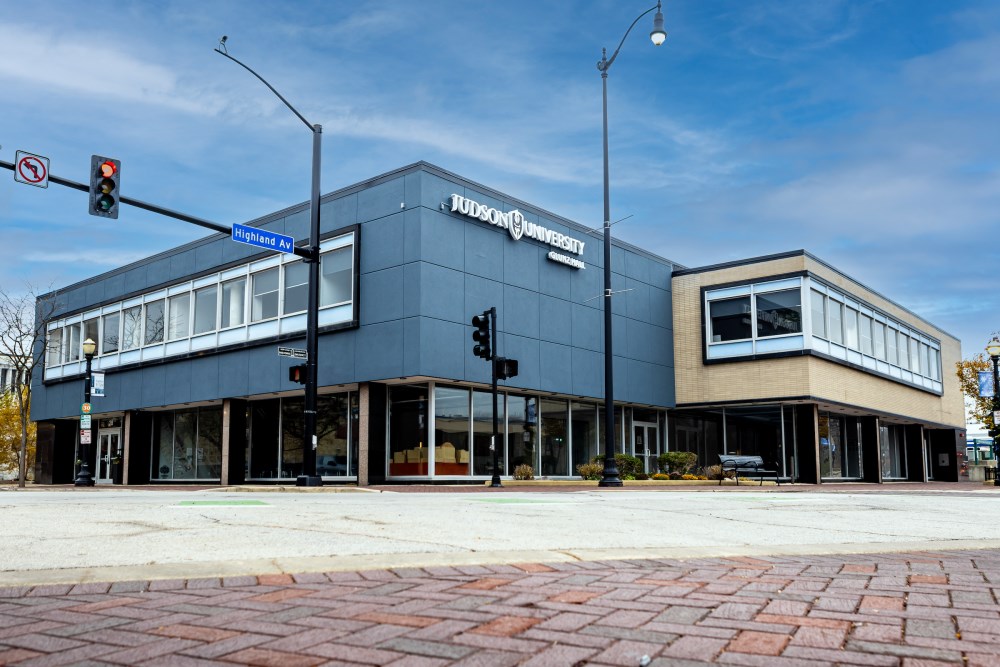
The building now houses thirteen apartments for approximately forty students, along with the Glunz Studio for Architecture and Urbanism on the ground floor. With donations from leading manufacturers, the project functions as a living lab. Every countertop, fixture, and finish becomes part of an informal curriculum, showing future architects how material choices shape both performance and experience. Many manufacturers involved will continue hosting workshops at Glunz Hall, giving students direct access to technical expertise and material science that extends beyond what textbooks provide.
A Living Laboratory
The original building offered clean lines, expansive windows overlooking the Fox River, and the kind of structural clarity that defined mid-century commercial architecture. The design team worked to amplify these qualities while layering in Art Deco warmth and industrial texture. This meant finding products that could speak to the building's history without mimicking it. The material palette needed to feel intentional and timeless, capable of bridging the gap between a 1960s bank and a 21st-century educational residence.
Delta
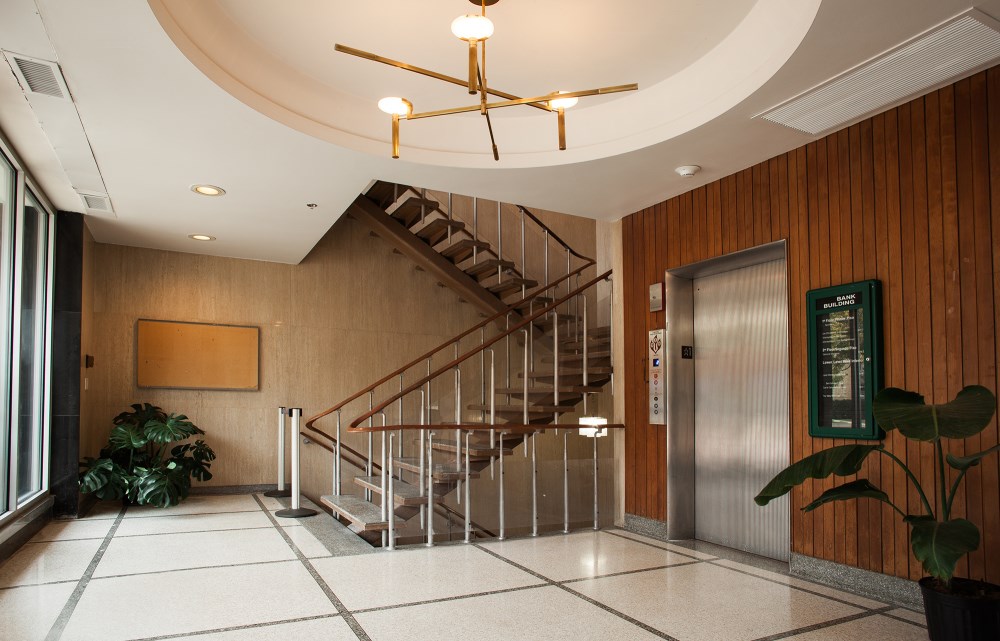
One of the most visible threads running through Glunz Hall is the consistent use of champagne bronze fixtures from Delta. The Velum and Trinsic collections appear throughout kitchens and bathrooms, their minimalist forms echoing the linear geometries of mid-century design. The warm metallic finish introduces refined contrast against exposed concrete and terrazzo.
These fixtures bring more than aesthetics. Diamond Seal Technology reduces leak points and simplifies maintenance. MagnaTite docking keeps pull-down sprayers securely in place. Monitor pressure-balancing valves maintain consistent water temperature. WaterSense certification ensures efficient flow rates. For students observing how small-scale components contribute to overall building performance, these details become daily lessons in specification and durability.
Visual Comfort
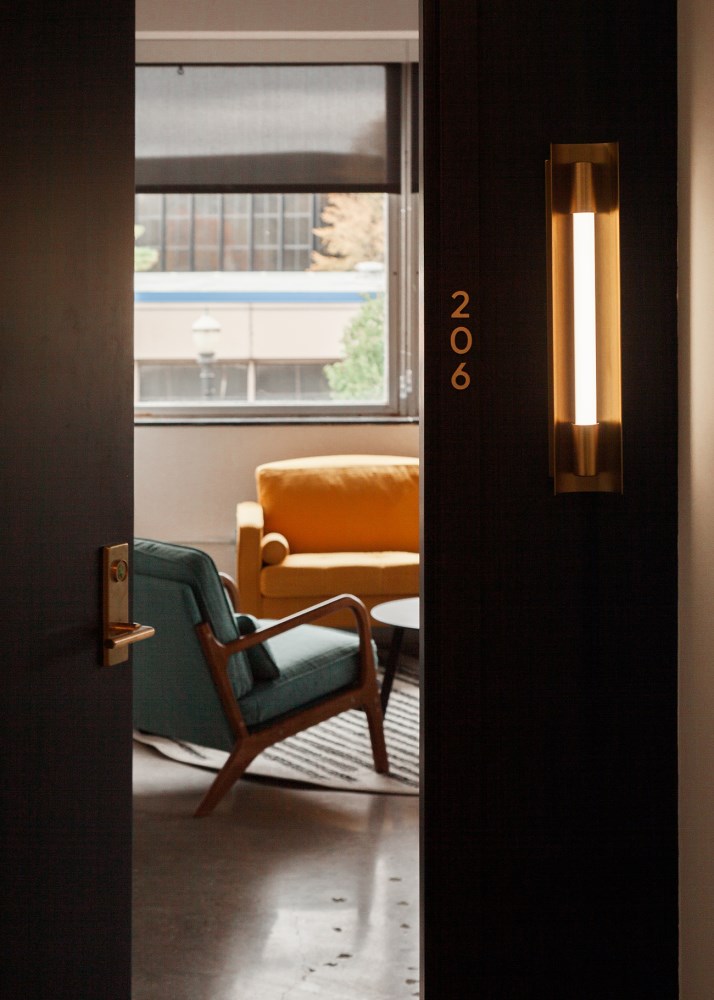
The champagne bronze language carries through to Visual Comfort lighting fixtures in communal lounges, hallways, and private units. Chandeliers, sconces, and flush-mounts maintain a coherent material story throughout the renovation. The hand-applied finishes and refined silhouettes harmonize with the warm metals elsewhere in the building. Robust construction handles the realities of student habitation. Students can observe how fixture scale mediates space and how finish influences perception of tone and texture.
Corian
Bathroom vanities feature Corian® Domino Terrazzo, a subtle historical reference that evokes the aggregate flooring and mosaic detailing common to 20th-century commercial buildings. The terrazzo pattern connects the new interiors to the structure's original era. The solid surface construction offers practical advantages as well. It's non-porous, renewable, and resistant to stains and moisture. Seamless integration with Kräus undermount sinks eliminates joints where moisture could collect, demonstrating how thoughtful detailing extends product lifespan.
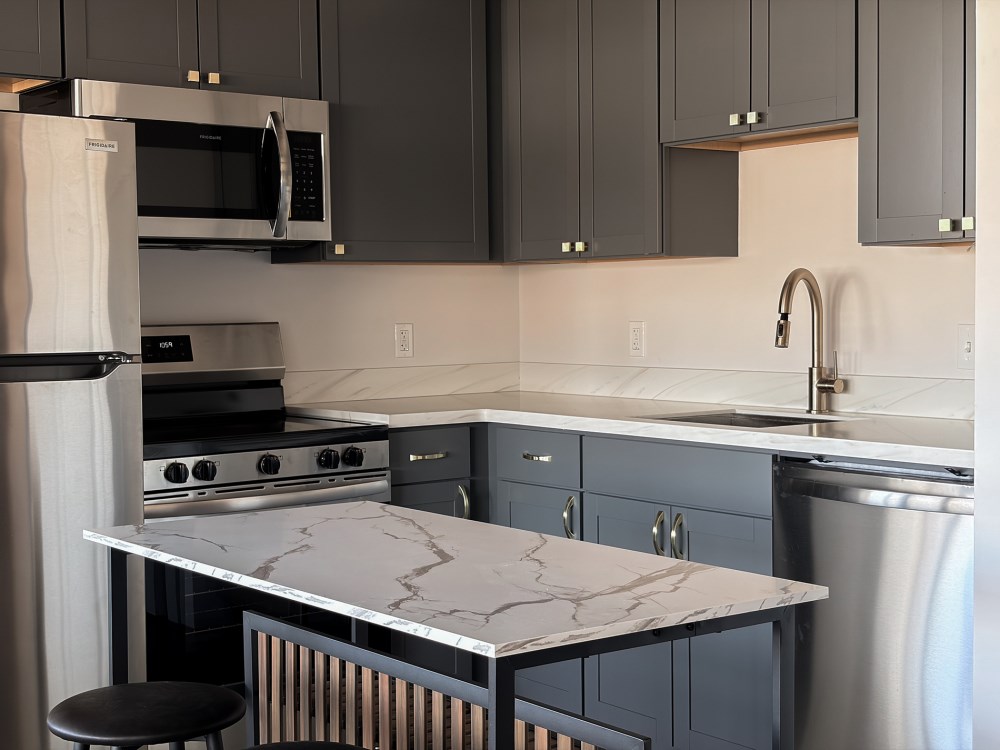
Kitchen countertops shift to Corian® Calacatta Greige, offering veined elegance in a neutral tone that pairs with the champagne bronze fixtures and BEHR Cameo White walls. Where the terrazzo recalls the building's past, the Calacatta pattern introduces contemporary refinement. Together, the two Corian materials express a quiet dialogue between old and new. Students experience this balance daily, cooking meals on surfaces that embody both preservation and progress.
Kräus
The Kräus Elavo sinks reinforce the project's emphasis on clean lines and material clarity. Their rectangular geometry and smooth white vitreous china complement the mid-century framework. The undermount configuration maintains the floating aesthetic of the vanities and the high-gloss porcelain glaze resists stains and cleans easily. These qualities are essential in shared student housing. ADA compliance and cUPC certification ensure the sinks meet institutional standards, showing students how code requirements intersect with design decisions.
Homasote
Some of the most critical material decisions remain invisible to residents. Sound attenuation determines whether spaces feel livable. Student housing compounds this challenge, balancing private study with collaborative work and everyday residential noise. Homasote 440 SoundBarrier within interior wall assemblies addresses this directly. The product achieves high STC ratings when paired with standard gypsum and resilient channels, reducing airborne sound transfer between units. Late-night design discussions and early-morning routines stay acoustically contained. Manufactured from recycled cellulose fiber, the boards also support the project's sustainability goals and contribute to LEED credits. For students learning about multi-family design, the Homasote panels illustrate how invisible decisions shape lived experience and resident wellbeing.
BEHR
The wall systems begin with the KILZ PVA Drywall Primer by BEHR, which equalizes surface porosity across old and new drywall sections. In adaptive reuse, subtle finish variations can betray transitions between historic and new construction. The primer creates a uniform substrate that ties the building's layers together visually, a detail that matters when preserving mid-century character.
Over that foundation, BEHR's PRO i300 Eggshell Interior Paint in Cameo White brings understated warmth to the interiors. The eggshell finish resists scuffs and stains common in multifamily housing while avoiding harsh reflectivity. The color reflects both natural and artificial light with a soft architectural glow. Both products are low-VOC and meet performance standards for institutional interiors, supporting indoor air quality for residents spending long hours in their live-work environments. Students observe how paint selection affects not just color but durability, maintenance cycles, and occupant health.
Trim-Tex
Trim-Tex drywall finishing components complete the wall assemblies with sharp profiles and crisp corners. Their vinyl and rigid PVC beads resist cracking and damage more effectively than traditional metal alternatives in structures undergoing subtle movement or reuse of existing framing. In a building where students are encouraged to critique every detail, the quality of these finishing elements becomes its own quiet lesson in craft and longevity.
FreeAxez
The Glunz Studio on the ground floor required infrastructure that could evolve with changing pedagogical needs. The Gridd 40 raised access floor system from FreeAxez answers this challenge with a low-profile platform that sits just inches above the original concrete. Power, data, and AV services run beneath the floor, accessible through tool-free modular panels that allow rapid reconfiguration.
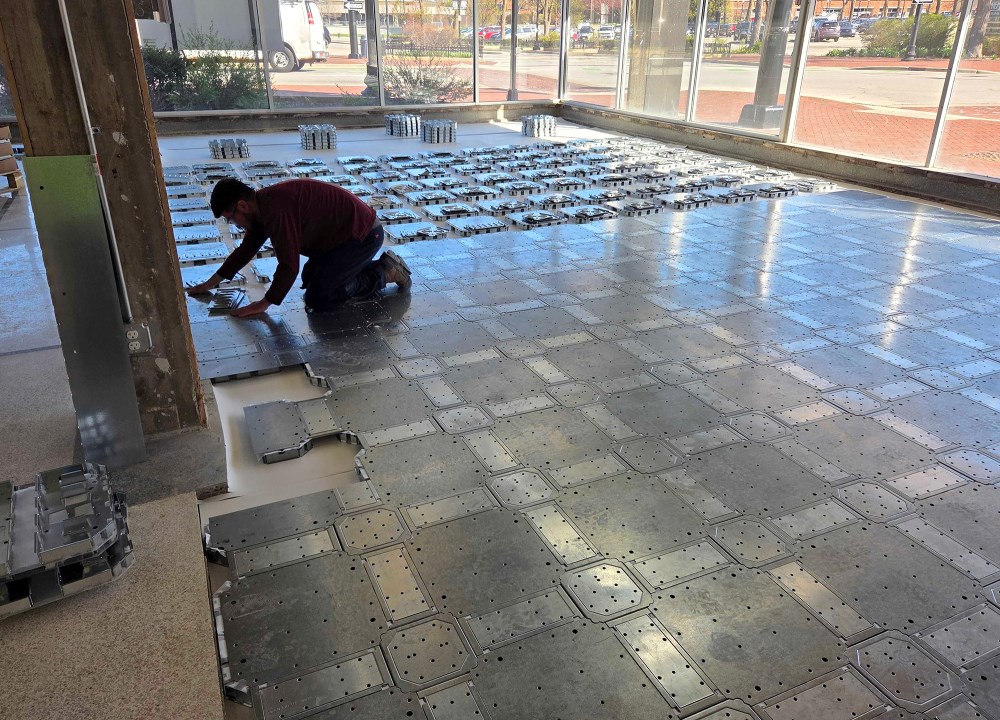
The system honors the bank headquarters' disciplined structural grid while delivering 21st-century adaptability. Furniture and equipment can shift from semester to semester, while cabling and network connections can evolve without damaging original fabric. The all-steel construction provides durability, and the clean lines underfoot maintain aesthetic alignment with the building's mid-century character. For architecture students, the raised floor demonstrates how technical systems can support flexibility while respecting historical context.
Education Through Experience
Glunz Hall gives students a setting where design intent shows up in everyday moments. The mid-century form holds its presence, while the modern systems and durable finishes create a calm, balanced home for both work and rest. Students absorb these cues as they cook, study, collaborate, and unwind. They see how materials shape atmosphere, how details guide movement, and how a consistent palette builds a sense of ease. The building becomes a quiet mentor, offering real-world examples of how thoughtful specification leads to environments that feel grounded, resilient, and well made. In this way, the building supports their growth as designers just as much as it supports their daily lives.
--
 Swatchbox is a premier sample fulfillment service for building product manufacturers. With proprietary software designed by insiders of the design community, Swatchbox helps manufacturers improve product sales and brand affinity by delivering material samples to the design community with speed, intelligence, and style. Learn more and join Swatchbox at www.swatchbox.com.



Comments